
A Walnut Creek Attorney Explains Community vs. Separate Property
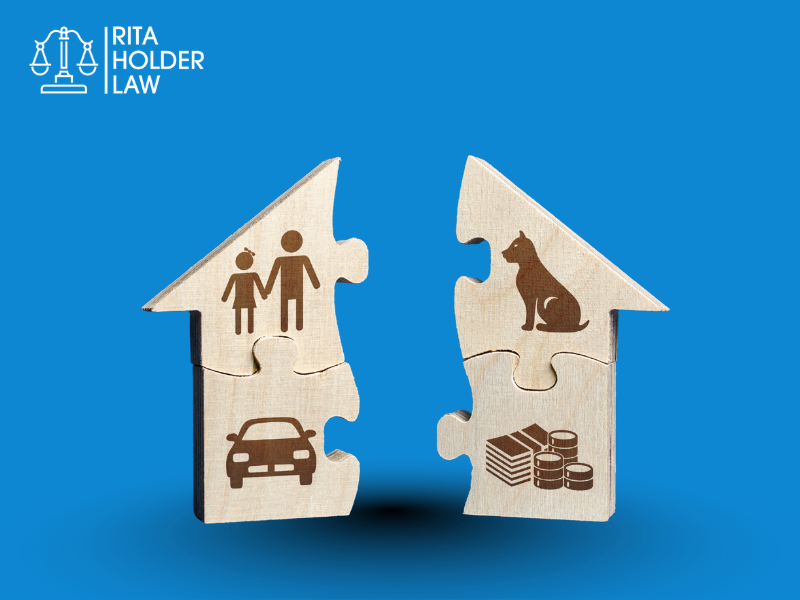
Dividing property during a divorce can be one of the most stressful and confusing parts of the process. In California, property division follows specific rules based on whether the asset is considered community property or separate property.
At Rita Holder Law in Walnut Creek, California, we help our clients understand their legal rights and work toward fair, equitable outcomes.
Key Questions to Consider:
- Was the property acquired before or during the marriage?
- Did a spouse inherit property or receive it as a gift?
- How long did the marriage last?
This article breaks down community vs. separate property, what happens when a judge decides on property division, and why the length of the marriage matters. While this guide covers common scenarios, every case is unique — so we strongly recommend consulting with an experienced Walnut Creek divorce attorney to protect your rights.
Because of this, your path to achieving the best outcome in your divorce is to work with us at Rita Holder Law. We have the experience to properly deal with anything that may be involved in your situation.
Community Property vs. Separate Property
What Is Considered Community Property?
California Family Code § 760 (2025) tells us that “Except as otherwise provided by statute, all property, real or personal, wherever situated, acquired by a married person during the marriage while domiciled in this state is community property.”
The property’s location doesn’t matter. What does matter is that the couple lived in California when they acquired the property.
Financial property, such as retirement plans, is included in community property. Furthermore, if interest or income is accumulated in a financial instrument, such as a 401(k), an IRA, or a pension, during the marriage, it is also treated as community property. To summarize, assets that are considered as community property include:
- Homes purchased during the marriage
- Vehicles
- Bank accounts
- Retirement accounts (including IRAs, pensions, and 401(k)s)
- Investment portfolios
In California, if a couple does not have a divorce settlement agreement, then a judge must divide the couple’s community property and debts equally. (See California Family Code § 2550 [2025].)
What Is Considered Separate Property?
Any property not classified as community property is considered to be owned by one of the spouses as “separate property”. Separate property normally stays with the spouse who owns it, and is not divided in a divorce.
California law defines the following items as separate property:
- property that was owned by a spouse before marriage.
- property that one spouse inherited or received as a gift.
- any money made from separate property (such as rents or profits).
Some properties may be in a “grey area’. For example, consider the following case. Before the marriage, one spouse is gifted real estate property with a house on it. Later, the couple lived in the house for 15 years, while they were married. Because one spouse owned the home before marriage, this seems to fit the criteria of separate property. However, because the couple shared the home throughout a long-term marriage, it’s possible that, after taking into consideration all factors in play, a judge may decide that the home is community property.
Legal Factors That Judges Consider
If the couple doesn’t have a written divorce agreement, and a judge is deciding how to distribute the property, it’s his or her responsibility to figure out how to divide the property evenly. The judge has some flexibility in terms of how he or she does this. For instance, to ensure that both sides receive assets of equal value, a judge may give an expensive new car to one spouse, and give the other spouse assets that are valued (in total) the same as the car.
Length of marriage is a key factor. If the marriage is deemed a “long-term marriage” (one lasting ten years or longer), and a judge is making the decisions about property distribution, he or she will take the long-term marriage into consideration, and may assign more items “community property” status than if the marriage was a shorter one.
Protecting Your Rights
When going through a divorce, you want to protect your rights; you want to make sure the property division is fair. A good way to do this is to take advantage of knowledge that’s been accumulated by an experienced Walnut Creek divorce attorney such as Rita Holder.
Rita Holder, founder of Rita Holder Law, brings decades of family‑law experience to the table. Let us safeguard what you have worked hard to build.
If you’re facing a divorce and want to ensure a fair and lawful division of your property, we are here to help. Give us a call today at 925-401-7885, or fill out the quick form on our Contact page to schedule a confidential consultation.
Rita Holder Law proudly serves families in Walnut Creek and surrounding Bay Area communities. Let us guide you toward a smoother future.