What are the residency requirements?
The California Courts Self-Help Guide tells us there are two residency requirements:
- You or your spouse must have lived in California for the past six months.
- In addition, you or your spouse must have lived in your current county for the past three months.
How long does it take to get a divorce?
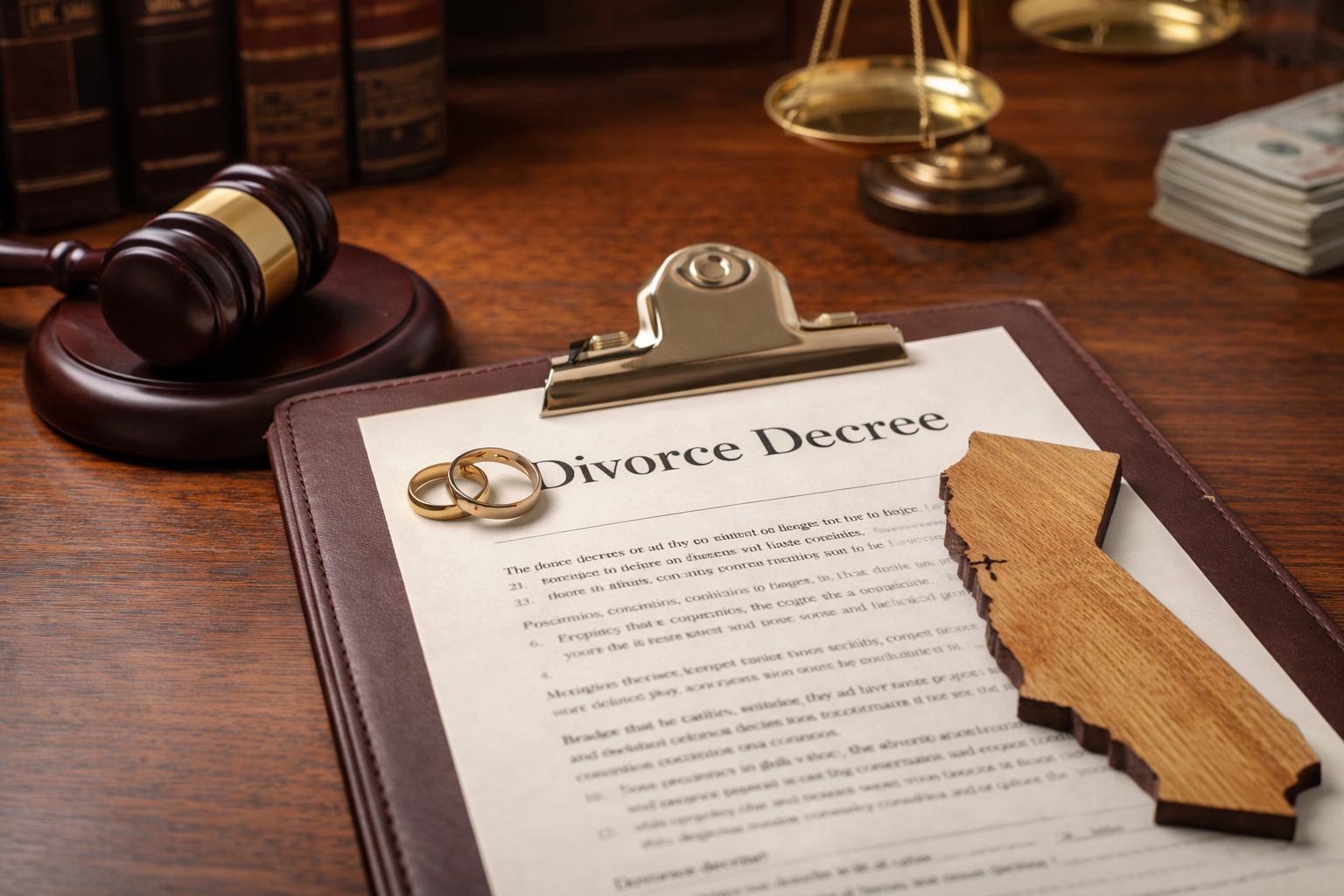
In California, it takes at least six months (starting from the date you file for divorce) to receive a divorce decree that legally ends the marriage. This “wait period” gives couples a chance to cool off and possibly change their minds.
How Does California Compare to Other States?
If a married couple are residents of Nevada, and both spouses sign the agreements, NevadaDivorce.org says that a Las Vegas divorce “… takes just weeks to finalize, usually one to two weeks, and rarely more than three.” In general, divorces in Nevada are much faster than in other states.
Reader’s Digest tells us that “California is notoriously slow because it mandates a six-month ‘cooling-off’ period to ensure both parties are truly committed to dissolving their marriage.” However, the article also mentions states that are even slower. For instance, before filing for a divorce, Vermont requires a one-year residency, and South Carolina requires a one-year separation.
What Are the Steps Involved in a California Divorce?
Based on the California Courts Self-Help Guide, there are four steps:
- Filing papers to begin the divorce process.
- Sharing financial information with each other.
- Making decisions about property, debts, children, and support.
- Submitting the final documents.
Step One: Filing Papers
Grounds for Termination of Marriage
When you file papers for a divorce, you must state the ground (reason) for the divorce. There are only two legal grounds for divorce in California:
- irreconcilable differences
- incurable insanity
The Superior Court of California, County of Sacramento tells us that if the legal ground for the divorce is irreconcilable differences, no proof is necessary. (Another way to explain this is that California is a “no-fault” divorce state.) “Irreconcilable differences” is by far the most commonly named reason for California divorces.
Step Two: Sharing Financial Information
In this step, you and your spouse fill out forms regarding your financial situation. This process is called “financial disclosure”, or simply “disclosure”. These documents provide details about what each spouse owns, what debts they have, how much they earn, and how much they spend.
The California Courts Self-Help Guide’s financial disclosures page warns that if a person is not honest about revealing their financial information, they may be required to pay the other person’s attorney fees, or they may lose property they did not reveal.
At RitaHolderLaw, we can help you make sure that you have shared all the necessary information.
Step Three: Dividing Property, Settling Debts, and Making Decisions About Children & Support
Property
Property division can be handled in any way that the couple agrees upon; each situation is unique. For instance, if one of the spouses owned items before the marriage, the couple may decide that those items will stay with their original owner.
Debt
Decisions made concerning settling debts are also unique to each case. A common debt in divorce cases is student loan debt. If a spouse has student loan debt that they incurred when they were single, the couple may decide the debt will stay with that spouse after their divorce.
Children and Support
When discussing the basics of alimony and child custody, the first thing to know is that alimony can be awarded if there are no children. However, long-term child support is often awarded when one spouse will be staying home to take care of the children.
Divorce.net says that in California law, alimony is called “spousal support”. The simplest way to arrange alimony is for a couple to agree that one spouse will pay the other a certain amount for a certain period of time. If there is no agreement, and a spouse asks for alimony, then a judge must decide if alimony will be granted as well as the specific terms.
The Divorce.net page on alimony also explains that there are two types of spousal support (alimony) awarded in California:
- temporary (which stops when the divorce is final)
- long-term (which occurs after the divorce)
According to the California Code, alimony stops if the recipient remarries, or if either spouse dies.
Step Four: Submitting the Final Documents
According to HelloDivorce.com, if you and your spouse have a written divorce agreement with detailed plans, the “final documents” step requires you and your spouse to fill out the forms listed below:
- Judgment (form FL-180)
- Signed divorce agreement (This will be unique to your situation.)
- Declaration for Default or Uncontested Dissolution or Legal Separation (form FL-170)
- Appearance, Stipulations and Waivers (form FL-130)
These documents are considered your final forms.
In some situations, these forms may require that you attach other documents to them, to provide details. In general, if your relationship is complex, you will have extra forms to fill out.
After you have prepared these documents, you and your spouse submit them to the court.
How Can I Get Help with My California Divorce?
At RitaHolderLaw, we are here to help you.
The information in this article answers many common questions about divorce in California. As you can probably tell, it can get complicated!
Contact us today. We’ll make sure that all your documents are filed properly, and that you complete all the steps necessary for your unique divorce situation.
Fill out our easy contact form, or call us at 925-401-7885.
We look forward to hearing from you.